Early May 2026. A pet accessories seller running across 16 Amazon marketplaces was deep into Prime Day prep.
The supply chain manager was working with an AI agent (Claude) connected to PROPAMP AI through MCP server — tracking inbounds from China, reconciling stock across FBA and AWD.
PROPAMP AI is a next-gen inventory management and profit tracking platform.
All the data the supply chain manager needed — stock on hand across every warehouse, open purchase orders with suppliers, in-transit units, expected arrival dates, stock forecasts, everything from Amazon Seller Central — was already inside the platform.
MCP is what lets an AI agent connect directly to other software — pulling data out, downloading files to your computer, and turning that raw data into new reports, files, or summaries.
PROPAMP AI's MCP is built for serious data volumes. You can ask the agent for months of sales across every SKU, every marketplace, every metric — and it pulls the whole thing in just a few requests and 1–2 minutes, with minimal token usage.
A typical drawback of MCP servers: a large data request drops the connection or fails outright. The agent ends up breaking it into tiny chunks and grinding through them one at a time — you can sit waiting half an hour for a single serious pull.
PROPAMP AI's MCP returns the full dataset fast, so the agent can start on complex multi-step analytics in munutes.
While pulling the projected arrival dates for the next inbound batches, Claude Code surfaced something the supply chain manager hadn't asked about:
"Some SKUs aren't going to have enough stock for Prime Day on certain markets. Others are sitting on heavy stock that won't clear before the next inbound.
Want me to write the PPC adjustments — what to slow down, what to push?"
Naturally, the supply chain manager said yes — keeping FBA stock at optimal levels is exactly what their KPI is built around. Both running out of stock and overstock hurt them.
A few minutes later, the agent produced a one-page memo: 3 SKUs to slow down (price up, PPC down) before they go out of stock, 2 to investigate (zero sales in France for 30 days), 7 overstock SKUs to push before the next batch arrives. Specific actions per marketplace, target velocity, exact price changes.

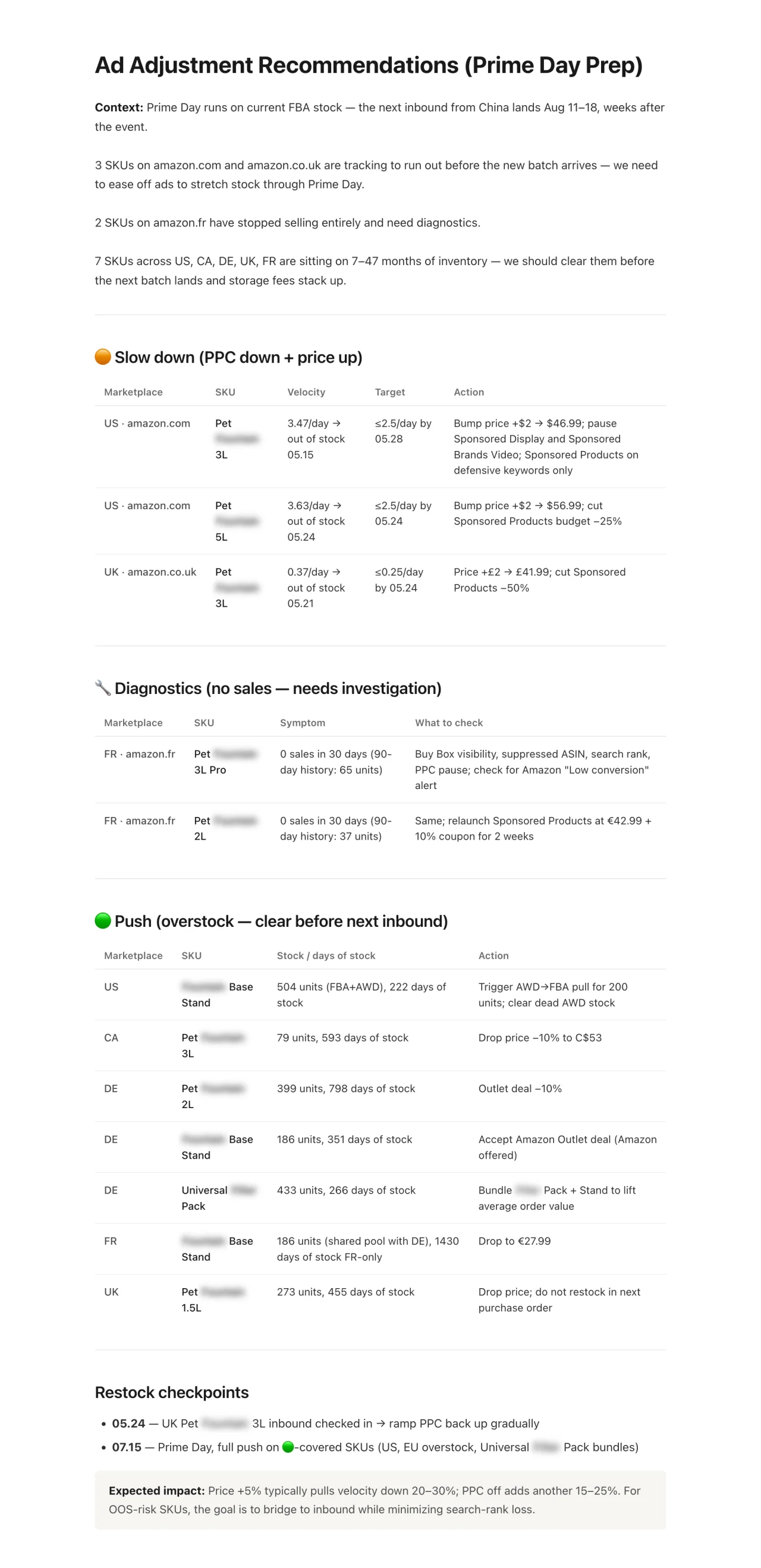
The supply chain manager forwarded the memo to the PPC manager. They reviewed it, confirmed the actions matched what they were seeing in the accounts, and started executing the same day.